Where to anchor without a depth sounder: choosing a spot and how much rode to pay out
Anchoring well means choosing a spot, checking the bottom holds and paying out enough rode. You can do it without a sounder, but you have to change the method: the chart tells you where to start, and your eyes and a lead line tell you the truth.
Why depth matters so much
Depth decides how much rode you need, whether the anchor will hold, and how much clear space you have around you as the boat swings with wind and current. Spain's Maritime Rescue Service (Salvamento Marítimo) puts it like this in its guide for recreational boaters: allow a minimum length of rode or chain of three times the depth or five times the length of the boat, and once anchored, check against landmarks on the coast that you are not dragging.
Step 1: pick candidates from the chart (at home or on the quay)
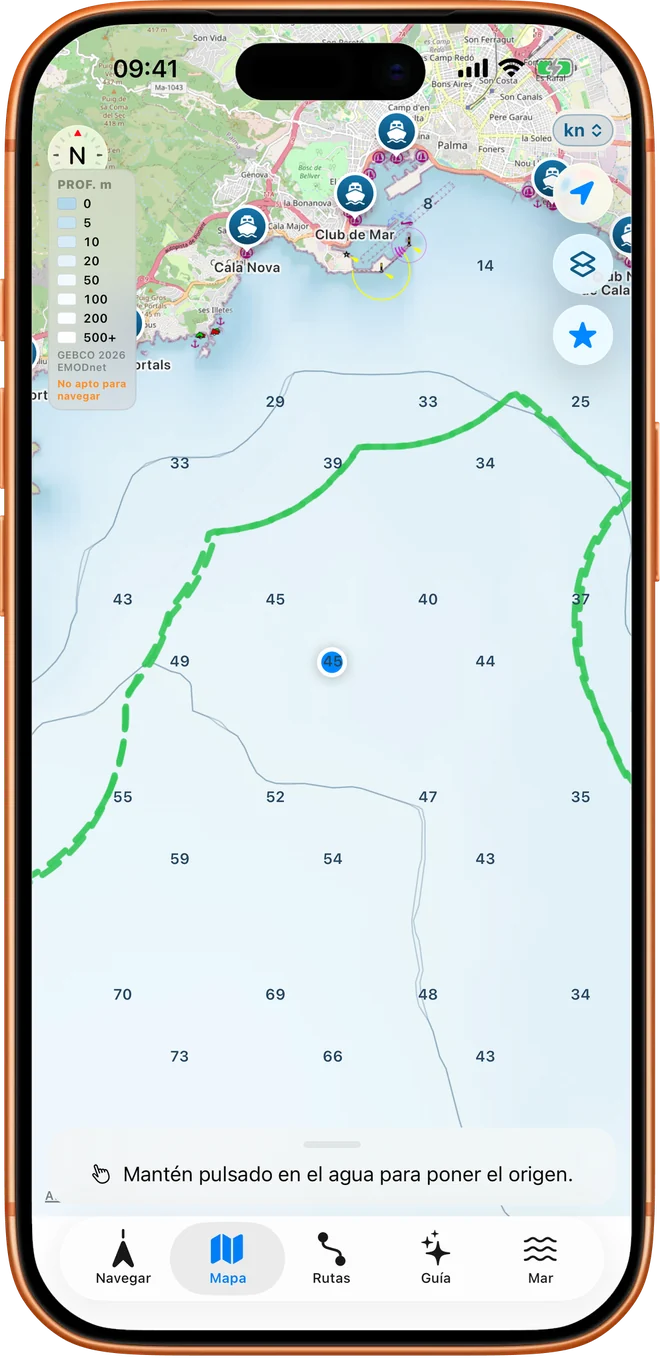
Before you leave, look at the depth map (in Embarca or the chart you use) for areas with 3 to 10 metres of water, sheltered from the forecast wind. It is the coarse filter: it lets you rule out places where the bottom drops suddenly or where there is no shelter. Two things to keep in mind:
- Chart depth is an estimate. GEBCO's global grid has cells of about 460 m and EMODnet's European grid about 115 m: a rock, a shoal or a step can be averaged out and not show. So it is good for choosing candidates, not for declaring a spot good.
- In the Mediterranean the tide is only a few tens of centimetres, so for anchoring purposes chart depth barely changes between high and low water. In the Atlantic it does change, and it adds to the depth you read.
Step 2: check the depth with what you do have on board
Once there, do not rely on the number alone. Three cheap ways to check without a sounder:
- A lead line. A weight on a line marked every metre. It is the sounder of old: you let it down until it touches and read it. It weighs next to nothing and fits in any inflatable.
- Your eyes. With polarised sunglasses and the sun behind you, you can see the bottom down to several metres in clear water. Tell pale sand (good holding) from dark rock and dark patches of seagrass.
- The anchor itself. When you lower it, the line tells you when it touches the bottom. Note how many metres you paid out: that is your depth.
Step 3: choose the seabed well
Sand holds better than smooth rock, and the anchor should never land on a Posidonia meadow. Posidonia (Posidonia oceanica) is a protected seagrass; it forms dark patches on the bottom and is easily torn up by an anchor. Anchoring on it can be a serious offence under Spain's Law 42/2007 on Natural Heritage and Biodiversity, and the Guardia Civil has reported boats for it. Always look for sandy gaps.
Step 4: how much rode to pay out
- The 3 to 1 minimum: rode paid out equal to or greater than three times the depth (plus the height of the bow above the water). With 5 m of depth, 15 m at least; with a fresh wind, up to 5 to 1.
- Minimum equipment. For navigation zones 5 and 6 (up to 5 and up to 2 miles), Royal Decree 339/2021 requires an anchor line at least five times the boat's length, and lets boats up to 6 m carry rope with no chain. A 3.5 m inflatable therefore needs about 18 m of line at the very least.
- Enough anchor. Light inflatables drag easily if the wind rises. Carry an anchor of a size appropriate to your boat, not the smallest you can find.
Step 5: check that you are not dragging
Once anchored, pick two landmarks on the coast that line up (a tree with a rock, the corner of a building with an aerial). If the alignment changes, you are dragging. Also look at where the boat will swing if the wind changes, and that there is clear space all the way round.
If you are going to dive
If you are going into the water, leave the boat anchored with generous rode, the engine off and, if possible, someone aboard watching it. A boat dragging with people in the water is one of the typical summer emergencies.
Salvamento Marítimo reminds divers to mark their presence with a regulation buoy or float, and other boats to keep at least 25 metres clear around dive markers. Spearfishing is prohibited in bathing areas. If you dive with a tank, do not depend on the estimated depth: plan the dive with the real depth that you measure yourself.
Summary in four lines
- Choose candidates from the chart, thinking about wind and coast.
- Check depth with a lead line and with your eyes.
- Anchor on sand, never on Posidonia, with at least 3 times the depth in rode.
- Check with landmarks that you are not dragging, and do not move away from the boat.
A case: two candidates and a lead line
Example scenario.
Pablo has an inflatable without a sounder and wants to anchor for lunch. At home he opens Embarca's chart, which is free, and compares two coves: both have about 5 or 6 metres a hundred metres from shore, but one is more exposed to today's wind. He picks the other. On site he opens Navigate: the chart depth under the boat matches what he sees. He drops the lead line to confirm, works out the rode and anchors on sand.
The app helped him rule out and choose where to start. What decided the anchoring was the lead line and his own eyes.
Sources
- Salvamento Marítimo, recreational boating: while under way (anchoring, dive markers; in Spanish). Checked on 14 October 2026.
- Salvamento Marítimo, underwater activities (in Spanish).
- Royal Decree 339/2021, safety and pollution-prevention equipment for recreational craft (BOE, in Spanish).
- Law 42/2007 on Natural Heritage and Biodiversity (BOE) and the news report on boats reported for anchoring on Posidonia in Xàbia. Some regions and protected areas have their own rules: check them.
- GEBCO and EMODnet Bathymetry, data resolution.