Sea safety: how to tell someone your return time
The best insurance for a short trip costs a two-line message. If something fails and you cannot call, the difference between hours and minutes is whether someone knows where to look and when to start worrying.
Why it is needed
Salvamento Marítimo stresses that between 60% and 65% of the emergencies of the recreational fleet it handles fall in the four summer months, and that human error is one of the main causes, followed by mechanical failure. An engine failure or a fall overboard when alone can leave you without a phone or without coverage. If nobody knows you are out, nobody misses you.
The trip plan, in five lines
Send this message (WhatsApp or SMS) to one or two trusted people before casting off:
Leaving: today at 10:00 from [name] harbour / [name] beach.
Going to: the area of [cove or spot], not beyond [limit].
Boat: [colour and length] inflatable with [no.] people aboard.
Back: at 14:00. If you have not heard from me by 15:00, call 112.
My phone: the usual one. I carry [VHF / no VHF].
Three things matter: where you will be, when you return and at what time the other person must act. An hour of margin is usually reasonable for a trip of a few hours. When you return, send another message: "back on land". Without that closing step the system breaks down and by the third trip nobody takes it seriously.
What the person who gets the message should do
- If the agreed time passes with no word from you, try to call you.
- If you do not answer, call 112 or 900 202 202 (the emergency numbers of Salvamento Marítimo) and give the plan: place, departure time, boat and people aboard. Salvamento reserves that contact exclusively for emergencies, and a person who sees a boat clearly in difficulty should alert them on those numbers.
- Not wait "a little longer": time passing without anyone searching is time in the water.
A breakdown is more common than a shipwreck, and an unnecessary alert is resolved with a "I'm fine" call. It is not a nuisance: it is what they are there for.
What to do yourself if you get into trouble
- With coverage: call 112 or 900 202 202.
- With VHF: a distress call on channel 16 explaining the situation, or an alert on channel 70 (digital selective calling) if your radio has it.
- With neither: hand flares (the three that are mandatory), a whistle and your arms. Keep your lifejacket on and the boat in sight.
A case: the trip you did not come back from on time
Example scenario.
Carlos goes out alone in his inflatable on a Sunday. Before casting off he turns on "Warn if I don't arrive", sets his return for 14:00 and picks his sister as the contact. At 12:30 the engine stops, half a mile off the coast and in an area with no coverage. He tries to restart it, fiddles with the spark plug and runs past his time. Around 12:50, after twenty minutes without receiving his position, his sister gets a first, gentle notice: it may just be a lack of coverage. At 14:30, half an hour after his return time, she gets the real one by SMS: Carlos has not arrived, this was his last position with its time, here is the link to the map. She does not have to have noticed or guessed anything: the warning reaches her by itself, even if Carlos's phone no longer works. She already knows what to do, because they talked it through: call Carlos and, if he does not answer, call 112 or 900 202 202.
How Embarca helps
Embarca has two features designed for this, both free for everyone: safety is never charged for.
- SOS: slide the red button and your emergency contacts, up to three, receive an SMS with your position and a link to follow you live. First, the app reminds you to call 112 or Salvamento Marítimo: Embarca does not replace the emergency services.
- "Warn if I don't arrive": you choose a return time and up to three contacts, and you set off. If the time plus a margin (30 minutes by default, you pick between 15 and 90) passes without you pressing "I'm back", the alert is sent by our server, not by your phone: each contact gets an SMS and, if you added their email, an email with your name, the planned time, your last known position with its time, the heading and speed you were making, a link to follow the route on a web page with nothing to install, the coordinates to read out to Maritime Rescue and what to do. Also, if you are on the water and the server stops receiving your position for 20 minutes (adjustable), your contacts get a gentle "signal lost" notice, because it may just be a lack of coverage. If your position then comes back, or you press "I'm back", the notice is retracted. It is free for everyone. Sharing your live route without a return time is a Pro feature.
While you share, the sheet has a big "I'm back" button, "+30 min" and "+1 h", and the time at which we would alert. There is also a reminder on your phone ten minutes before your time and at the time, with the same buttons in the notification. The buttons that disarm the alert ask you to unlock the phone: nobody who finds your phone on the lock screen can cancel it. Without coverage the app keeps your position and sends it as soon as the signal returns; the link expires by itself 24 hours after the last data.
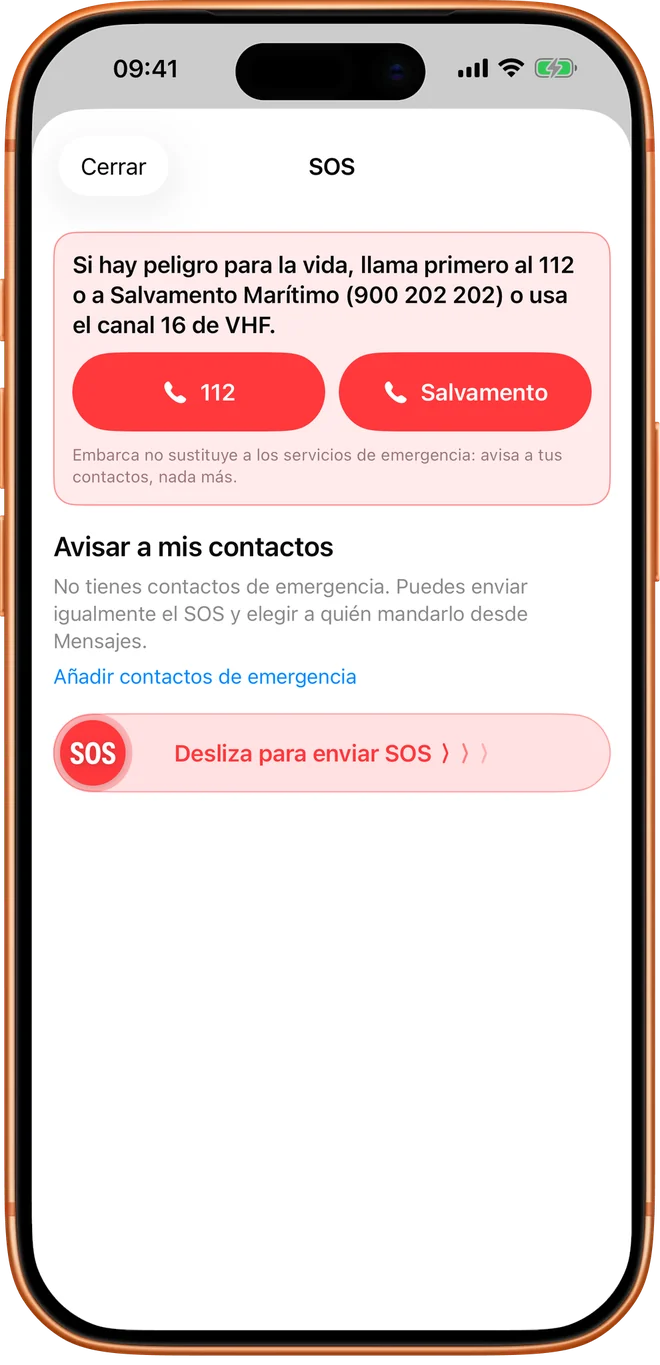
Honest limits. Embarca does not replace 112 or Salvamento Marítimo: if life is in danger, call them first. The SMS only goes to Spanish mobile numbers; a contact in another country can only be warned by email. The alert carries the last position that reached the server: if the phone gets wet or runs out of battery in an area without coverage, the points stored since the last time there was a network are lost with it. And "I'm back" without a network does not arrive until there is coverage: if you return to land and do not press it with a network, the alert will go out anyway (and as soon as you press it, it is retracted). That is why a waterproof pouch, a power bank and, if you go far, a VHF make sense. More in what to bring on a trip and what to do if you lose coverage.
Sources
- Salvamento Marítimo, before setting off (recreational fleet emergency statistics and trip planning; in Spanish). Checked on 14 October 2026.
- Salvamento Marítimo, distress calls: phones 112 and 900 202 202, VHF channel 16, alert on channel 70 or 2,187 kHz.