The 2-mile limit of the Spanish Navigation Licence: what it is and what happens if you exceed it
The "2 miles" is repeated so much that almost everyone thinks it means "2 miles from the coast". It does not. It is measured from a port, marina, departure beach or place of shelter, and in daylight only. This guide separates what the Royal Decree says from what circulates by word of mouth.
This is general information, not legal advice. What binds is the text in the BOE (Spain's official gazette) and the interpretation of your local Maritime Captaincy. Sources are linked at the end. The regulations are Spanish; other countries differ.
The three cases that get mixed up
Royal Decree 875/2014, which regulates recreational boating qualifications in Spain, provides three different cases for small boats. They get confused because in two of them the limit is the same, 2 miles.
| Case | Who | How far | Conditions |
|---|---|---|---|
| No qualification (art. 10) | People aged 18 or over, in motor boats up to 5 m long and 15 hp maximum rated power (without a power-reducing device), or sailing boats up to 6 m | No more than 2 miles from the departure port, marina or beach | Daytime only |
| Navigation Licence (art. 11) | Aged 18 or over (16 with written consent of parents or guardians), recreational craft and personal watercraft up to 6 m long | No more than 2 miles from a port, marina or place of shelter | Daytime navigation only |
| Basic Navigation Skipper (PNB) | Boats up to 8 m long | Up to 5 miles from a port, marina or place of shelter | A qualification, with an exam |
To complete the picture: the Recreational Craft Skipper (PER) extends this to 12 miles from the coast and up to 15 m long (art. 8.c).
What the 2 miles are measured from
This is the nuance almost nobody has clear. The limit is not "2 miles from any point of the coast": it is a maximum distance from the port, marina, departure beach or place of shelter. If you leave a port and follow the coast for several miles, you can be 300 metres from land and still more than 2 miles from the port, which takes you outside your entitlement.
The rule says "place of shelter" for the licence and "departure beach" for the no-qualification exception. Which places count as shelter is something the Maritime Captaincy specifies, so if you leave from a cove or a ramp that is not a port, ask them what your reference point is.
An example with numbers
A 3.35 m inflatable with a 9.9 hp outboard is under the 5 m and 15 hp of the article 10 exception. If the skipper is 18 or over, they can go out without a qualification, in daylight and no more than 2 miles from the port, marina or departure beach. With the Navigation Licence the distance is the same, but it applies to boats up to 6 m and you must hold the licence. All of this concerns only the qualification: registration, insurance and the boat's paperwork are separate matters.
What happens if you go beyond it
Nothing happens when you cross the line: nobody measures you from a satellite. The risk is elsewhere, and it is threefold:
- Administrative penalty. The consolidated Spanish Ports and Merchant Navy Act classes as a serious offence (article 307) exceeding the limits of the recreational qualification held, or acting as skipper without sufficient qualification. Article 312 sets fines by type of offence; for serious offences against maritime traffic regulation they can reach EUR 120,000. Those are legal maximums; the actual penalty depends on the case file.
- Insurance. If there is an accident and you were outside your entitlement, the insurer may dispute cover. That is a policy matter: read yours, as they vary.
- Safety. This is the underlying reason. The further you go, the longer to a shelter, the less coverage, the greater the chance the weather changes before you are back. Two nautical miles is about 3.7 km: the limit is designed to keep shelter always nearby.
How Embarca helps
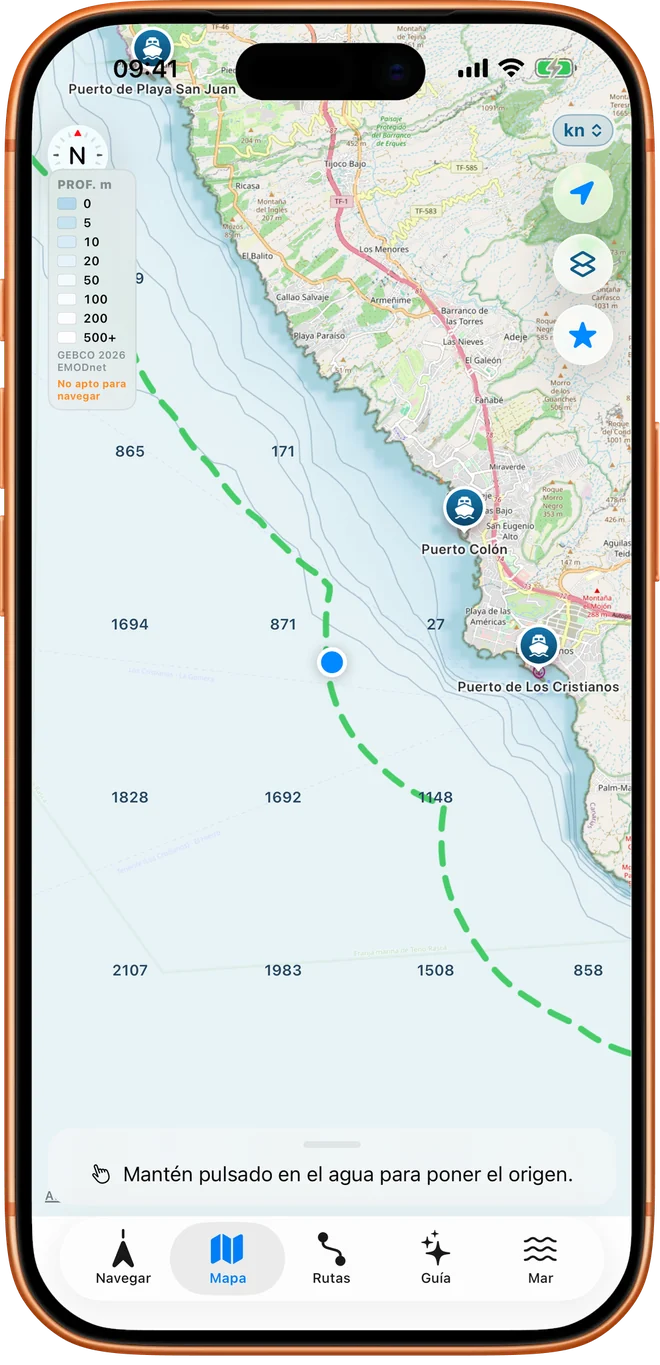
Embarca draws your maximum distance on the map according to the qualification you choose (2 miles with the Licence or no qualification, 5 with the PNB, 12 with the PER) and warns you when you approach or leave it. It only informs: it never stops you sailing. One important caveat: by default the app computes the distance to the coast. If your entitlement is measured from a port or shelter, check your reference point yourself, because that is what counts.
A case: the line on the map
Example scenario.
Sergio has the Navigation Licence and fancies following the coast to a beach 5 miles away. In Embarca he picks his qualification and the map draws his line at 2 miles from the coast, free. He sees the straight route goes outside it, but hugging the coast fits. He takes that one. The line only informs and stops him from nothing; he is the one who decides.
Sources
- Royal Decree 875/2014 of 10 October regulating qualifications for recreational craft (BOE, in Spanish): articles 8, 9, 10, 11 and 13. Consolidated text; the BOE itself notes the consolidated version is informative.
- Consolidated text of the Ports and Merchant Navy Act (BOE, in Spanish): articles 307 and 312.
- Basque Government, information on the Navigation Licence.
- Maritime Captaincies: Directorate General of the Merchant Navy.