How to watch dolphins and whales within the rules: distances and regulations in Spain
Seeing a dolphin from a small boat is one of the best things the sea offers, and Spanish law allows it with clear rules. The main one: you do not chase the animals. If they come to you, let them. These are the distances, speeds and prohibitions of Royal Decree 1727/2007.
Which rule applies
Royal Decree 1727/2007 sets protection measures for cetaceans (dolphins, pilot whales, rorquals, sperm whales...) in Spanish waters: internal waters, territorial sea, contiguous zone and exclusive economic zone. It applies to everyone, including someone out for a trip in an inflatable. Its penalties refer to Law 42/2007 on Natural Heritage and Biodiversity. The text sets no fine amounts: that law does.
The "mobile protection space"
The rule defines a cylinder around the animal or group (two or more animals within 50 metres of each other), with three zones by distance:
| Zone | Distance | What you may do |
|---|---|---|
| Exclusion | 0 to 60 m | Entering or staying is prohibited (except in an emergency or for urgent safety and health reasons). No swimming or diving. |
| Restricted stay | 60 to 300 m | Up to 2 boats at a time. Entry is prohibited if there are adults with calves or isolated calves. |
| Approach | 300 to 500 m | Waiting to enter the restricted zone: at most 2 boats, in radio contact. |
The space also includes an aerial zone (500 m radius) and an underwater zone (down to 60 m), where staying is also prohibited.
How to approach, step by step
- Constant speed, no more than 4 knots, and never faster than the slowest animal in the group.
- A gentle, converging approach, at about 30 degrees to the animals' heading. Never head-on, from behind or crossing in front.
- A parallel course, with no sudden changes of heading or speed.
- Neutral after starting: after starting the engine, wait at least one minute in neutral and change revs gradually. Going astern is prohibited, except in an emergency or to avoid a collision.
- Do not circle the animal or group, cut across their path, or come between a calf and its mother.
If they come to you
Common and bottlenose dolphins often approach boats and swim by the bow. The rule covers it: if cetaceans come within 60 metres, put the engine in neutral or disengage it at low revs, or stop if needed. Do not start the engine or propeller while they are within 60 m; if necessary, wait a few minutes until they start to move away and start gently. For dolphins and porpoises, the rule allows keeping speed and heading. Switch off any sounder or sonar: the sound disturbs them.
What you never do
- Touch them, or bring people close to touch them.
- Feed them or throw food, rubbish or objects.
- Block, intercept or separate a group.
- Make loud or shrill noises, including underwater sound.
- Swim or dive inside the exclusion zone (within 60 m).
- Use sonar or acoustic devices to locate or steer them.
If the animals show alarm (sudden changes of heading or speed, leaps, repeated flight), leave the space as soon as possible and avoid disturbing them as you go. If you find an injured or dead cetacean, report it at once with its position to the Guardia Civil (maritime service) or the Navy, and to the Maritime Captaincy through Salvamento Marítimo.
Where to see dolphins with real odds
In the Mediterranean, the species most often seen from a small boat are the common, bottlenose and striped dolphins. They gather where food is, and food gathers where the seabed changes slope: at the depth contours. So reading the contours on the chart gives you a clue: a canyon or marked drop-off off your coast is a good candidate. The zones shown in Embarca come from protected areas and official studies, not guesses, and each card carries its source. There are no guarantees: they are wild animals.
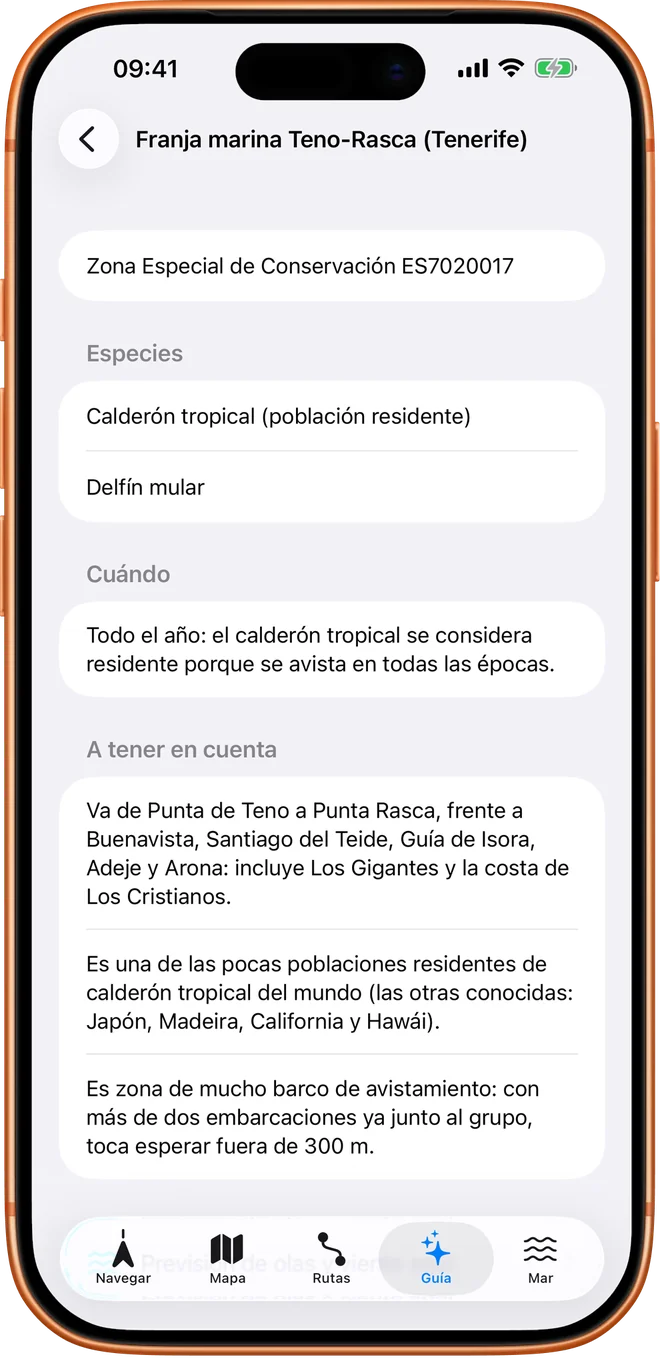
Orcas in the Strait. If you sail in the Strait of Gibraltar or the nearby Atlantic and orcas interact with your boat, Salvamento Marítimo has a page with specific recommendations (linked below). It is a different situation with different guidance from normal wildlife watching.
A case: watching dolphins without chasing them
Example scenario.
Ana and her partner head out mid-morning. In Embarca's cetacean guide (free) they looked up the nearest sighting zone, with its source, and in the forecast (Pro) they saw the window of daylight hours with the sea flat enough to spot a fin. They reach the zone and slow down. At about 300 metres they see blows. They do not turn toward them: they put the engine in neutral and wait.
Two minutes later a group of bottlenose dolphins comes by itself and swims beside the bow. Ana opens the guide's species cards and identifies them: bottlenose, not common or striped. When they swim off, the pair restart gently. No chase, no fine and a photo for the logbook.
Sources
- Royal Decree 1727/2007 establishing protection measures for cetaceans (BOE, in Spanish): articles 2 to 7 and annex II. Data on this page read from the consolidated text on 14 October 2026.
- Law 42/2007 on Natural Heritage and Biodiversity (BOE), to which the penalty regime refers.
- MITECO, responsible navigation around cetaceans guide (PDF, Spanish).
- Salvamento Marítimo, interactions with orcas.