A day out with children is not decided by how good the plan sounds, but by the wind, by the line you carry and by who knows where you are. This is the story of one Sunday of a family with a RIB and Embarca on their phone: what they look at, what they decide and what lies outside what the app can do.
Simulated case. The family, the boat, the harbour and the numbers are invented to illustrate how Embarca is used. They are not a real customer and this is not a testimonial. What is said about the functions, and about what is free and what is Pro, is what the app does. The figures of the day (wind, times, fuel use) are plausible, not measured.
Who they are (the person and their boat)
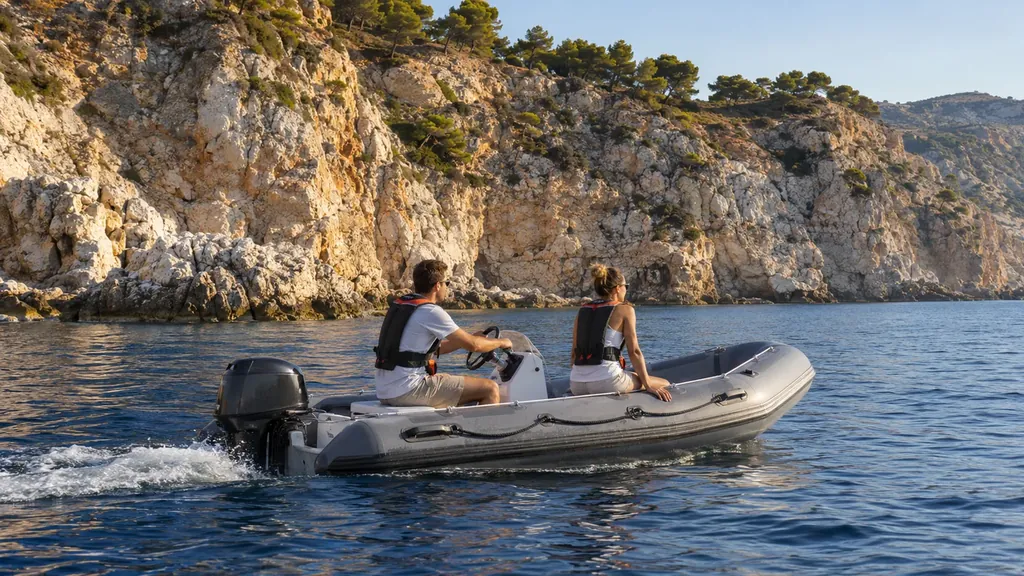
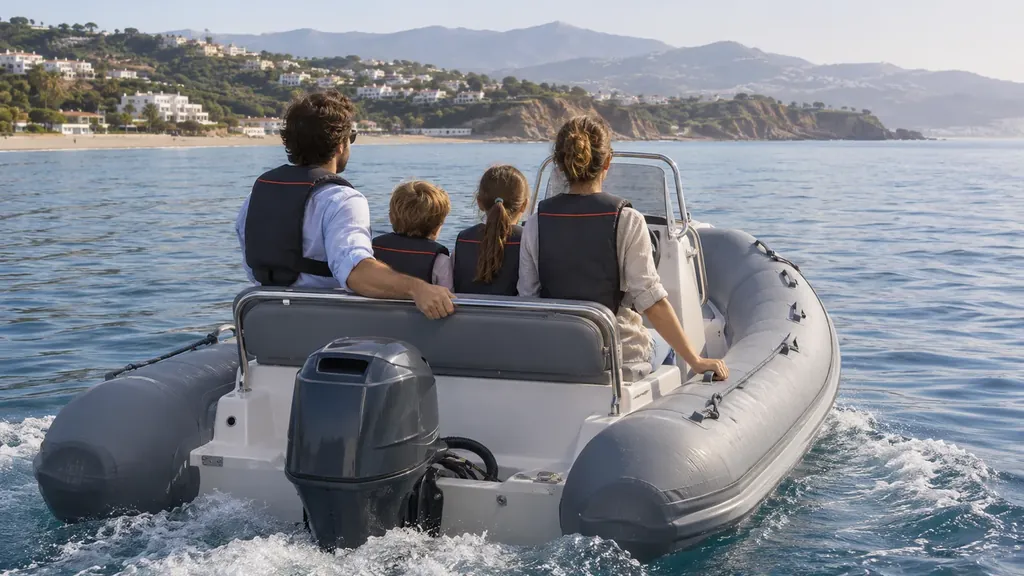
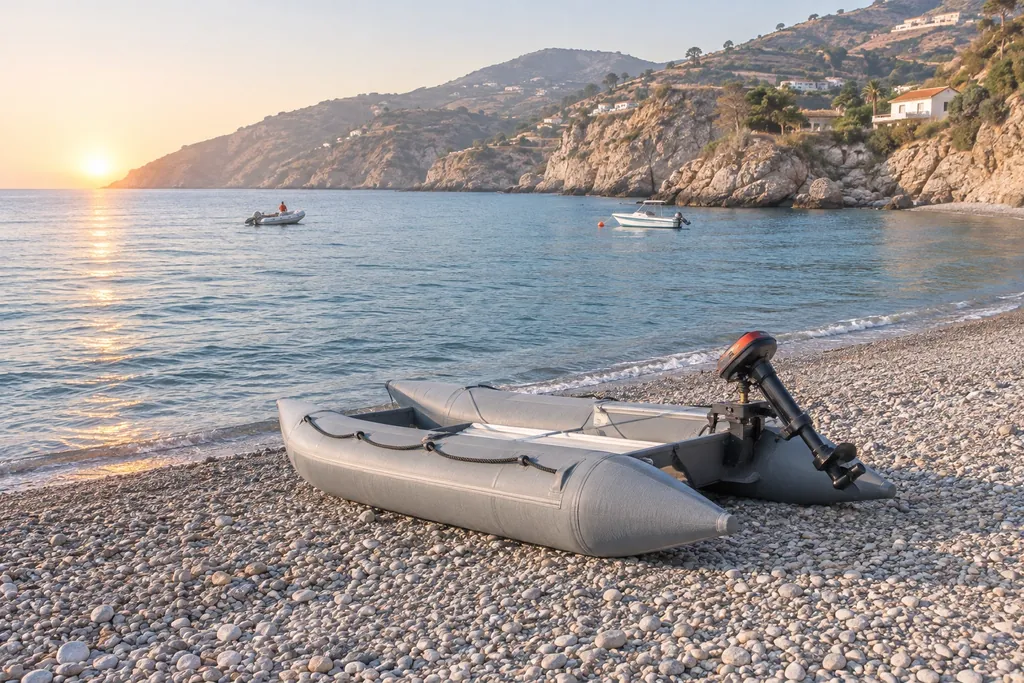
Raúl is 41 and a sales agent. His wife, Laura, 39, is a nurse. They have two children, Hugo, 9, and Mara, 6. They live in Vélez-Málaga and have had a 4.5 metre RIB for two summers, with a rigid hull, inflatable tubes and an outboard bolted to the transom. They bought it second-hand and keep it on a trailer in the grandparents' garage.
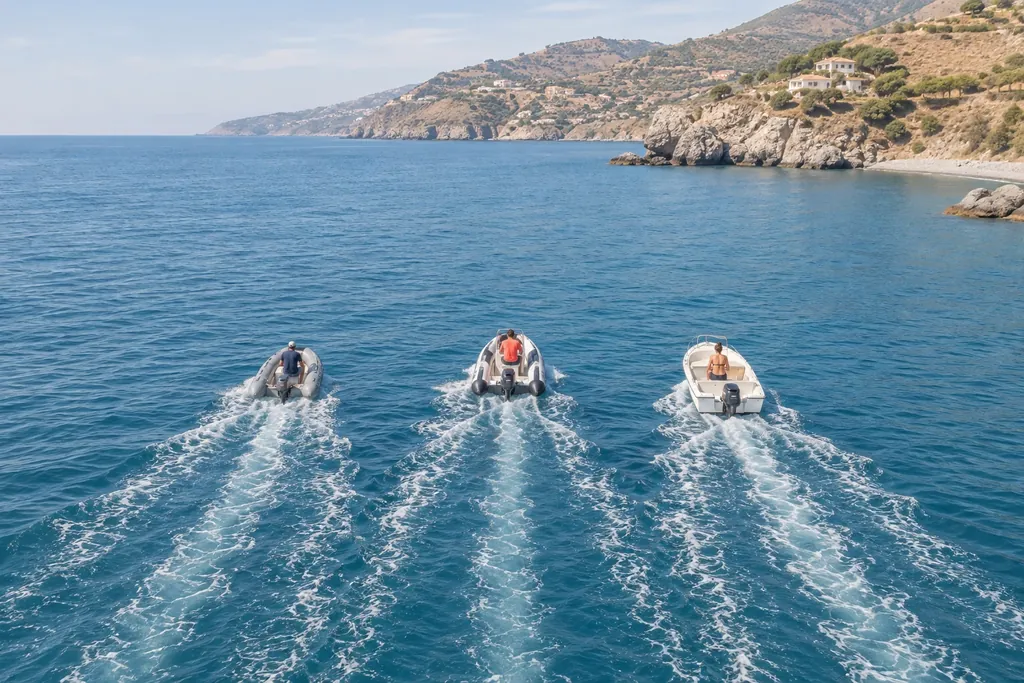
Raúl holds the Basic Navigation Skipper (PNB) qualification, which, as explained in the guide to the 2-mile limit, covers boats up to 8 metres and no more than 5 miles from a port, marina or place of shelter. Laura has no qualification and does not drive the boat. Their usual outings last a day: they launch in the morning from the ramp at Caleta de Vélez, go to a cove to the east, swim, have lunch on board and come back in the afternoon.
They are not people who make passages. They are a family with a small boat who spend the day on it and who, for that very reason, have little margin for error: four people, two of them children, and a summer Sunday.
What worries him (the pain, with concrete numbers)
- The wind rules. On a 4.5 metre RIB with two children, the difference between 8 and 14 knots is the difference between a swimming day and a day of spray and tears. According to the table in the wind guide, 10 to 16 knots is already "choppy sea" and above 16 you do not go out in a small inflatable. Raúl does not want to find out with the children aboard.
- Anchoring. Anchoring for a swim is the riskiest moment: people in the water and the boat still, which nobody sees if it drags. Without a sounder, he does not know how much water there is or how much line to pay out.
- The alert. Laura wants her mother to know where they are and when they will be back. But her mother forgets to ask and they, with the children, forget to tell her.
- The time budget. Between loading, launching, getting to the cove, eating and coming back with the trailer, it adds up to almost six hours. If the wind comes in at two, the day is over, and the children do not understand why.
- Lifejackets and equipment. Four lifejackets in different sizes, flares, anchor, line, bailer. The what-to-carry guide gives the list, but it has to be gone through, not just read.
These are five different things, and almost all of them are settled at home, on Thursday night, not on the ramp on Sunday.
Before going out (forecast, return alert, equipment)
Thursday night: deciding which day
Raúl opens Embarca's seven-day forecast. That function is Pro: opening it starts their 3-trip trial, which includes everything in Pro. Saturday shows levante at 14 to 18 knots, with higher gusts in the afternoon. Sunday, light poniente: 6 to 8 knots until midday, rising to about 11 to 14 after two. It is the split the guide describes: levante usually brings humidity, low cloud and swell; poniente usually leaves clearer skies, but raises wind chop as soon as it settles in.
They choose Sunday. And they set a family rule, stricter than the guide's: mean wind up to 10 knots, gusts up to 15 and waves up to 0.5 metres. With that rule, Sunday is good until 14:00, and by then they want to be in the harbour. It is not a legal norm: it is their own criterion with two children aboard.
Friday: choosing the cove and checking the equipment
- The line. In Embarca they choose "PNB" as their qualification and the map draws their limit at 5 miles from the coast (it is free). The cove they have in mind is about 3 miles east of the ramp. They know, as in the case of someone who has just got a licence, that the line measures from the coast and their entitlement is measured from the port or shelter, so they count the miles from the harbour, with the line as a support.
- The bottom. On the depth map, the cove has between 3 and 5 metres about 80 metres from the shore, and the shape of the shading tells them the bottom slopes gently. It is an estimate; they will confirm it with the lead line, as the anchoring guide explains.
- The equipment. With the what-to-carry list in hand, they go over the four lifejackets (one per person, of a suitable size, children included), the three flares, the bailer, the inflator, the torch, the oars and the lead line. The anchor line is 30 metres long: the guide asks for a minimum of five times the length, that is 22.5 m for their boat. Water for everyone, caps, sun cream, a change of clothes and a tow rope.
- The ramp. They phone the harbour to confirm hours and fee. On a summer Sunday there will be a queue, so they plan to be there at 08:30. More on this in the ramps guide.
Saturday night: the return alert
Laura sends her mother, Pilar, the five-line message from the return-alert guide: where they are going, in what boat, how many they are, what time they will be back and at what time she should call 112. And that same night she sets up "Warn if I don't arrive" in Embarca, with three contacts: her mother, her brother-in-law Sergio and her sister. The alert is free.
The outing, hour by hour
A Sunday in late July. All the times and figures in this section are examples.
- 07:30. Last forecast. They check the AEMET warning for Costa de Andalucía Oriental (no warning) and Embarca's forecast for today (free): at 09:00, 6 knots with gusts of 9 and a 0.3 m wave; at 12:00, 8 with gusts of 12; at 14:00, 11 with gusts of 15 and a 0.5 m wave; at 16:00, 14. It matches Thursday. Their plan: leave the cove at 13:00 at the latest.
- 07:45. Alert on. Laura sets the return time to 14:30 and keeps the default margin of 30 minutes. If nobody has pressed "I'm back" by 15:00, the server sends an SMS to the three contacts with the last position. Pilar already knows what would reach her and what to do.
- 08:30. Ramp. They arrive before the queue. Raúl reverses the trailer while Laura waits on the pontoon with the bow line. The children get out of the car only when the boat is tied up, with their lifejackets already on. Once it floats off, the car goes to the car park and the boat stays tied up.
- 09:15. They leave the harbour. Raúl starts the engine with the boat tied up and checks that the propeller is clear. The children sit low and well held, not on the tubes. In Navigate he sees speed, heading, distance to the coast and the estimated arrival time.
- 09:40. In the cove. They stay outside the marked bathing area, if there is one. Chart depth shows about 4 m; the lead line, 3.8 m, with pale sand and no dark patches. With 3.8 m plus half a metre of bow above the water, the 3-to-1 rule gives about 13 m; with children in the water and a little more margin, they pay out 20 of their 30. They take two marks on the shore, the roof of a white house and a pole: as long as they stay aligned, the anchor is not moving.
- 10:00 to 12:30. Swimming. Engine off and the propeller away from the swimmers. There is always an adult on board: first Raúl, then Laura. The children swim with their lifejackets on and close to the hull. Every ten minutes, whoever is on board checks the marks. Hugo asks about dolphins: Raúl explains the 60-metre rule from the cetacean guide: if they come on their own, engine in neutral and wait, and they are never chased.
- 12:30. Lunch on board. Sandwiches and fruit, caps on. Raúl checks today's forecast again, with coverage: no change.
- 13:00. Pack up. Anchor aboard, lifejackets on and the children down low. They go at moderate speed: the 3 miles back take a little over 20 minutes.
- 13:45. Queue at the ramp. It is Sunday and there are six boats ahead. At 14:20, with the boat still waiting its turn on the water, Raúl sees the reminder ten minutes before the return time. From the notification he presses "Extend 1 h", which asks him to unlock the phone, and tells Pilar by WhatsApp. There is no hurry: they wait.
- 14:55. On land. Boat on the trailer, in the car park. He presses "I'm back" and the alert is disarmed. Laura writes to her mother: "back on land". They covered 7.1 miles in 4 h 15 min, using 9 of the 25 litres in the tank, well away from the reserve of thirds. The trip stays in the logbook, free (the last 3).
What they decide with Embarca (and what they decide without it)
The app contributes what can be looked at at home, with a cool head: the day, the candidate cove, the alert. What happens on the water, with the children and with the anchor, is decided by the adults aboard.
What Embarca does NOT solve for them
- The real depth. It is a chart estimate, with cells of 115 to 460 metres. A rock or a step may not show. It is no use for anchoring blind.
- The type of bottom and seagrass. They check that by eye and with the lead line. The anchoring guide reminds you that anchoring on seagrass can be a serious offence.
- The anchor. There is no anchor alarm in Embarca that we know of: if the boat drags, whoever is aboard sees it with the marks.
- The official forecast. The forecast uses open global models (Open-Meteo with data from ECMWF, DWD and NOAA). They serve to decide which days are worth it. If the AEMET warning for the area is yellow or higher, they stay home, whatever the app says.
- Live wind. It is a forecast, not a sensor. A local gust or an early breeze is noticed by Raúl, not by the phone.
- The children's swim. Neither the supervision nor the lifejacket nor the current. That belongs to the adults.
- Coverage and battery. The alert is sent from the server, but if the phone loses its network or its battery, the points saved since the last time there was a signal are lost with it. The SMS only goes to Spanish mobile numbers. Hence the waterproof pouch and the power bank. And the SOS does not replace 112 or Salvamento Marítimo: if there is danger, you call them first.
- Equipment and paperwork. The app does not check the lifejackets, the insurance or the boat's papers.
- What a bigger boat needs. No AIS, no NMEA instruments, no chartplotters, no official navigation charts.
What it costs them (Free versus Pro)
We do not give the price: Pro is a one-off payment, no subscription, with the price in the store. Here, what the family uses from each side.
Sharing the route live without a return time, which they did not use, is also Pro. A trip counts if it is a recorded track of at least 15 minutes, with at least 10 at sea and a displacement of 500 metres or more. During their first 3 trips the family has everything, because the trial includes the Pro functions. If they buy Pro, according to the Embarca website, the one-off payment covers the whole family through the store's Family Sharing. If not, they still have what matters: safety is never charged for. More in Free versus Pro.
What we would do the same and what we would not
The same.
- Deciding the day at home and in good time, and setting a family rule stricter than the guide's.
- Leaving early, to be in the harbour before the breeze comes in.
- Choosing the cove with the chart and accepting it with the lead line and by eye.
- Paying out more line than the minimum and watching the anchor with marks while they swim.
- Leaving a relative a written plan and "Warn if I don't arrive", and pressing "I'm back" at the end.
Differently.
- We would carry a handheld VHF: with two children, a boat 3 miles from the harbour and possibly no coverage in the cove, it is the plan B that does not depend on the phone.
- We would set the return margin taking the ramp queue into account, not just the wind. One hour of margin is not much on a Sunday.
- We would ask the Maritime Capitanía what their reference point is: Embarca's line does not settle it.
- We would try the lifejackets on the children the day before, well adjusted and with a gentle tug from the shoulders: on the pontoon, with the queue behind you, it is too late.
And if yours is a single person with a 3.5 metre inflatable, there is this other one.
How to try it
- Download Embarca (free, on iPhone and Android) and pick your qualification to see your distance line.
- At home, a couple of days before, look at the chart of the cove you want, and at today's forecast when the day comes.
- Set up "Warn if I don't arrive" with one contact, and do a short test to see how it is closed with "I'm back".
- When you want, press "Try 3 trips free" and decide after using them.
And before going out with children, read when to go according to the wind, how to anchor without a sounder and how to tell someone your return time. There is a table with everything on the home page.
Sources